When you pin on those officer ranks, you accept a burden that goes far beyond just following orders. You're now held to a higher standard, a code of conduct that governs every aspect of your life. Article 133 of the UCMJ, "conduct unbecoming an officer and a gentleman," is the formal enforcement of that code.
This isn't just about avoiding crimes. It’s about maintaining the absolute integrity and public trust that military leadership demands. At its core, Article 133 addresses any action that disgraces you as an officer or shatters your credibility to lead. It applies to all commissioned officers, cadets, and midshipmen, whether you're in uniform or not.
Understanding the Officer Code of Conduct
For officers, cadets, and midshipmen, military service isn’t just a job; it’s an identity that demands an unwavering ethical compass. Think of Article 133 UCMJ not as a list of prohibited acts, but as the guardian of that compass. It's designed to govern your entire life, not just your duty hours.
The language of the article is intentionally broad. It has to be. It's meant to cover a huge range of behaviors that might not be technically illegal but are absolutely toxic to good order and discipline. The whole point is to protect the dignity and honor of the entire officer corps.
The fundamental idea is simple: your actions must never cast doubt on your integrity, your judgment, or your fitness to lead others into harm's way. This standard follows you everywhere, 24/7.
What Makes Article 133 Unique
Most UCMJ articles are straightforward—they prohibit specific crimes like theft (Article 121) or assault (Article 128). Article 133 is different. It’s subjective. It hinges on whether an action "disgraces" the officer or "seriously compromises" their standing as a leader. This means the context of your behavior matters just as much as the act itself.
This concept has been a pillar of military law since the original Articles of War, always enforcing a stricter standard for leaders. The Manual for Courts-Martial (MCM) gives examples like making false official statements or dishonorably failing to pay your debts—things that obliterate credibility. You can find more practical insights from military law experts who break down its real-world applications.
Because its scope is so wide, prosecutors often tack it on to other charges. It allows them to address not just the underlying crime but also the institutional damage the officer’s alleged misconduct caused.
"There are certain moral attributes common to the ideal officer and the perfect gentleman, a lack of which is indicated by acts of dishonesty, unfair dealing, indecency, lawlessness, injustice, or cruelty." – Manual for Courts-Martial
Article 133 UCMJ at a Glance
To really get a handle on this powerful article, it helps to see its core components laid out clearly. The table below gives you a quick snapshot of the concepts we'll be diving into.
| Component | Explanation |
|---|---|
| Who It Applies To | Exclusively targets commissioned officers, cadets, and midshipmen. Enlisted personnel face different articles for similar misconduct. |
| Type of Conduct | Covers any action, on or off duty, that personally dishonors the officer or seriously undermines their standing as a leader. |
| Legal Standard | The conduct doesn't have to be a separate crime. The real test is whether it's "unbecoming" to the high standards expected of an officer. |
| Intentional Vagueness | The language is deliberately broad. This allows it to address unforeseen situations that could tarnish the integrity of the officer corps. |
This framework is your starting point for understanding how a single action can have career-ending consequences under the UCMJ.
What Prosecutors Must Prove for a Conviction
To get a conviction under Article 133 UCMJ, the government can't just point to a questionable action and call it a day. Military prosecutors have a heavy burden. They have to prove several specific elements beyond a reasonable doubt. If they fail on even one, their case collapses.
Think of it like a three-legged stool. For the stool to stand, all three legs must be solid. If your defense attorney can kick out just one of those legs, the whole structure comes crashing down.
The Three Pillars of an Article 133 Prosecution
The government's entire case is built on proving these three distinct elements. Every single one is a battleground where a sharp defense lawyer can dismantle the prosecution's story.
Status as an Officer, Cadet, or Midshipman: First, they have to prove that at the time of the alleged offense, you were a commissioned officer, cadet, or midshipman. This is usually the easy part, often handled with a quick look at official service records.
Commission of an Act or Omission: Next, the prosecution has to prove you actually did (or failed to do) something specific. This isn't about feelings or suspicions; it requires hard evidence—witnesses, documents, text messages, you name it.
The Conduct Was "Unbecoming": This is the heart of the fight. It's the most subjective element and where most of these cases are won or lost. The government must convince a panel that the act or omission legally qualifies as "conduct unbecoming an officer and a gentleman."
It’s not enough for the conduct to be embarrassing or in poor taste. This is where a skilled defense shines.
Defining the Vague Standard of "Unbecoming"
So, what does "unbecoming" really mean? The term feels slippery, but the Manual for Courts-Martial gives it legal teeth. The conduct has to be something that, in dishonoring the officer personally, also seriously compromises their character as a gentleman.
The legal test boils down to this: did the conduct compromise the officer’s standing as an officer and a gentleman? This includes acts that show a lack of integrity, fairness, justice, or basic morality, ultimately damaging their fitness to lead troops.
In simple terms, prosecutors have to show your behavior was more than just a momentary lapse in judgment. They need to prove it fundamentally damaged your moral fiber to the point where it impacts your leadership ability and discredits the armed forces. That's a very high bar.
For example, being rude to a server at a restaurant probably doesn't cut it. But getting drunk in public and then lying to the responding MPs almost certainly does, because that shows a failure of both judgment and integrity.
The prosecution's job is to connect the dots between your action and this high standard. Your defense attorney’s job is to show that while the conduct may have been ill-advised, it never rose to the level of disgracing your character or compromising your standing in the military. Making that distinction clear is the key to building a powerful defense against an Article 133 UCMJ charge.
Common Scenarios That Lead to Article 133 Charges

The phrase "conduct unbecoming" can sound vague and old-fashioned, but it hits with the force of a hammer in the real world. Knowing the common situations that trigger an Article 133 UCMJ investigation is crucial for any officer who wants to stay out of trouble.
These scenarios aren’t just about breaking a specific rule; they’re about actions that erode the very foundation of leadership. They tend to cluster into three buckets: dishonesty, abuse of authority, and personal misconduct that stains the uniform. Every single one connects an officer's private character to their public fitness for command.
Dishonesty and Lack of Integrity
There's no faster way to end a career. Acts of dishonesty strike at the heart of an officer's credibility, making this the most frequent path to an Article 133 charge. Once your word is worthless, so is your leadership.
Here’s what this looks like on the ground:
- Making a False Official Statement: This isn't just a little white lie. We're talking about falsifying a TDY voucher, fudging a readiness report, or lying to an investigator.
- Cheating: Getting caught cheating at a PME course or on a promotion board is seen as a complete failure of character. It tells the command you'll take shortcuts when it matters most.
- Larceny or Financial Fraud: Stealing government gear or playing games with a government travel card isn't just theft. It’s an act that shows you lack the moral fiber required to lead troops.
These aren't just mistakes; they're seen as a conscious choice to put personal gain ahead of the truth. That's a trait that is fundamentally toxic to military leadership.
Abuse of Power and Position
An officer's rank is a tool, not a toy. Misusing that authority is a profound breach of trust, and Article 133 is the tool the command uses to hold officers accountable when they cross that line.
This category often involves actions that exploit or mistreat others:
- Fraternization: This is about more than just a relationship. It's about creating an unduly familiar dynamic with an enlisted service member that shatters the chain of command.
- Maltreatment of Subordinates: Using cruel, abusive, or demeaning language toward a junior service member isn't just bad leadership; it's a chargeable offense.
- Sexual Harassment: Creating a hostile or intimidating work environment through unwanted comments or advances is a classic example of abusing one's position.
A pivotal Supreme Court case, Parker v. Levy (1974), really cemented the far-reaching power of Article 133. The court upheld the conviction of an Army captain who made public anti-war statements, deciding his conduct disgraced his status as an officer. This case confirmed that the article is intentionally broad to punish a whole spectrum of dishonorable acts. Read the full details about how this case defined military-specific discipline.
Personal Misconduct and Public Discredit
Finally, Article 133 reaches deep into an officer's personal life. The military’s view is simple: an officer represents their service 24/7. Behavior in your private life can absolutely bring public disgrace upon the armed forces.
Common scenarios that fall under this umbrella include:
- Adultery: While society's views may have shifted, adultery is still on the books. It becomes a UCMJ issue when it's deemed prejudicial to good order and discipline or brings discredit upon the service—like having an affair with a subordinate's spouse.
- Dishonorable Failure to Pay Debts: A consistent pattern of financial irresponsibility can be framed as a character flaw, making an officer seem unreliable and untrustworthy.
- Public Intoxication or Drug Use: Getting drunk and disorderly downtown or using illegal drugs reflects terribly on the officer and, by extension, the entire military.
These examples drive home a critical point: under Article 133 UCMJ, the line between your professional and personal life is blurry at best. An action taken miles from any military post can have career-ending consequences if the command decides it has compromised your standing as an officer and a leader.
The Punishments and Long-Term Career Consequences
An allegation under Article 133 UCMJ is more than a professional bump in the road; it’s a direct assault on your entire future. A conviction doesn't just come with a penalty—it sets off a chain reaction of consequences that can permanently wreck your life, both in and out of uniform. The stakes couldn't be higher, and getting a handle on them is the first step in facing this fight.
The punishments handed down at a general court-martial are brutal. They represent the military’s nuclear option for an officer, designed to be career-ending and personally devastating.
Maximum Authorized Punishments
If convicted, an officer stares down a range of penalties that can be stacked together. The maximum sentence for an Article 133 violation is as stark as it gets:
- Dismissal from the Service: Don't mistake this for an administrative separation. A dismissal is the officer's version of a dishonorable discharge. It’s a punitive, criminal action that permanently strips you of your commission and ends your military career in absolute disgrace.
- Forfeiture of All Pay and Allowances: A court-martial has the power to stop every dollar of your military income. This financial gut punch is often immediate, placing unimaginable strain on you and your family when you can least afford it.
- Confinement: Depending on the offense, a conviction can also lock you away for a period decided by the court-martial panel.
These aren't just hypotheticals pulled from a manual. They are the tools a court-martial uses to enforce the uncompromising standards of the officer corps, and they are used frequently in serious cases.
The Career-Ending Ripple Effect
The fallout from a conviction spreads far beyond the immediate sentence. A dismissal, for example, saddles you with a permanent federal criminal record that will follow you for the rest of your life. It creates massive, often impossible, hurdles in the civilian world. One single event can erase decades of your hard work and sacrifice.
The real punishment of an Article 133 conviction often starts after the gavel falls. It's a permanent stain that poisons your job prospects, your benefits, and even your personal reputation long after you've paid your debt.
The long-term impacts are catastrophic, creating a domino effect that topples your professional and personal life:
- Loss of Security Clearance: A conviction is a near-certain death sentence for your security clearance. This not only torches your military career but also blacklists you from a huge number of federal jobs and defense contractor roles that require one.
- Ineligibility for Government Benefits: A punitive discharge like a dismissal can make you ineligible for the very veteran's benefits you earned—the G.I. Bill, VA home loans, and VA medical care can all be stripped away.
- Barriers to Civilian Professions: Trying to become a lawyer, doctor, pilot, or police officer? Many licensed civilian professions have "good moral character" clauses. A federal conviction for conduct unbecoming an officer makes getting or keeping those licenses next to impossible.
These lasting consequences show exactly why an Article 133 UCMJ charge demands an aggressive, strategic defense from day one. For officers facing this nightmare, it's also critical to understand the administrative fallout. Learn more about what officers should expect when preparing for a Board of Inquiry, which can be a parallel and equally career-threatening battle.
Building a Defense Against an Article 133 Charge
When you're facing an Article 133 UCMJ allegation, it can feel like your career is over. But an accusation is not a conviction. The very thing that makes this article so dangerous for officers—its broad, subjective language—can also be its biggest weakness in court. A seasoned military defense attorney knows how to exploit that ambiguity and turn it into a strategic advantage.
A real defense isn't about playing catch-up with the government's case. It's about getting ahead of them and systematically taking their arguments apart. This means attacking the very definition of "unbecoming," scrutinizing every piece of evidence, and building a powerful counter-narrative about your character and your service.
Challenging the Definition of Unbecoming
The heart of a strong defense is a direct assault on the vaguest element: was the conduct really "unbecoming"? The prosecution has the burden to prove, beyond a reasonable doubt, that your actions seriously wrecked your standing as an officer. That is a very high bar.
A smart defense will argue that while your actions may have been a mistake or shown poor judgment, they didn't cross the line into criminal misconduct. It's about reframing the story to show that a personal error doesn't mean you lack the fundamental moral character required of a military leader.
Leveraging the Lack of Notice Defense
One of the most powerful tools in the toolbox is the "lack of notice" defense. The argument is simple: the rules were so unclear that a reasonable officer wouldn't have known their actions were off-limits. If military custom or regulations don't specifically forbid it, how were you supposed to know it was a crime?
This angle is especially effective in cases involving off-duty conduct or things done in your personal life. Your lawyer can argue that you were never given fair warning that this specific behavior would violate Article 133 UCMJ, which plants a seed of reasonable doubt.
The core issue here is fairness. If the standard is so vague that officers are left guessing what's allowed, a conviction based on that guesswork is fundamentally unjust. A good defense hammers this point home.
Attacking the Evidence and Presenting Mitigation
Beyond attacking the legal definition, a tactical defense means tearing into the government's evidence. We're talking about questioning witness credibility, finding inconsistencies in their stories, or showing that the evidence just doesn't add up to something as serious as conduct unbecoming.
Even if the evidence seems solid, the fight is far from over. This is where a mitigation strategy comes in. The goal is to secure a lesser punishment if a conviction appears likely by showing the command exactly what they stand to lose by hammering you.
Key mitigation tactics include:
- Presenting Compelling Character Evidence: We gather letters and testimony from respected peers, subordinates, and commanders who can paint a picture of a dedicated leader whose career is worth saving.
- Highlighting an Exemplary Service Record: Your entire career—awards, glowing evaluations, and tough leadership jobs—becomes evidence that the alleged misconduct was a one-time anomaly, not who you are.
- Demonstrating Rehabilitation Efforts: If the incident involved personal struggles like stress or alcohol, showing you've taken proactive steps toward treatment can have a massive impact on sentencing.
These strategies can't wait. They require immediate action from the moment you know you're in trouble. To see why timing is so critical, you should understand when to involve a military defense lawyer during an investigation. An Article 133 charge is a serious fight, but with the right game plan, it's a fight you can win.
Your First Steps If You Are Under Investigation
If you think you're being investigated for an Article 133 UCMJ violation, what you do in the next 48 hours can make or break your entire military career. This isn't a moment for hesitation or wishful thinking. You need to take immediate, disciplined action to wall off the threat and start building your defense.
The most critical first move is simple: invoke your right to remain silent and your right to an attorney. Whether it’s CID, NCIS, OSI, or CGIS knocking on your door, your only words should be a polite but unbreakable refusal to answer questions without a lawyer. So many good officers fall into the trap of trying to talk their way out of it, thinking they can just explain everything and clear their name.
That instinct is a snare. Investigators are trained to get confessions and incriminating statements. Every word you say can, and absolutely will, be twisted to fit their narrative against you.
Creating a Defensive Perimeter
Once you’ve invoked your rights, the mission shifts to damage control. You need to control the environment and stop the bleeding while you find the right legal counsel. Your job is no longer to explain yourself—it’s to preserve every single one of your options.
- Go Radio Silent: Do not discuss the investigation with anyone. Not your buddies, not your mentors, and definitely not your commander. Those conversations aren't privileged, and you're just creating more witnesses for the prosecution.
- Preserve Everything: Start gathering any documents, emails, text messages, or records that could possibly be relevant. Do not delete a single thing. Doing so can look like destroying evidence, which can land you in even deeper trouble with separate charges.
- Find Your Lawyer, Now: Begin searching for an experienced civilian military defense lawyer immediately. As you start this process, it's natural to have questions; understanding the typical lawyer consultation fee can be a good place to start.
This flowchart lays out the basic structure for building a solid defense against an Article 133 charge.
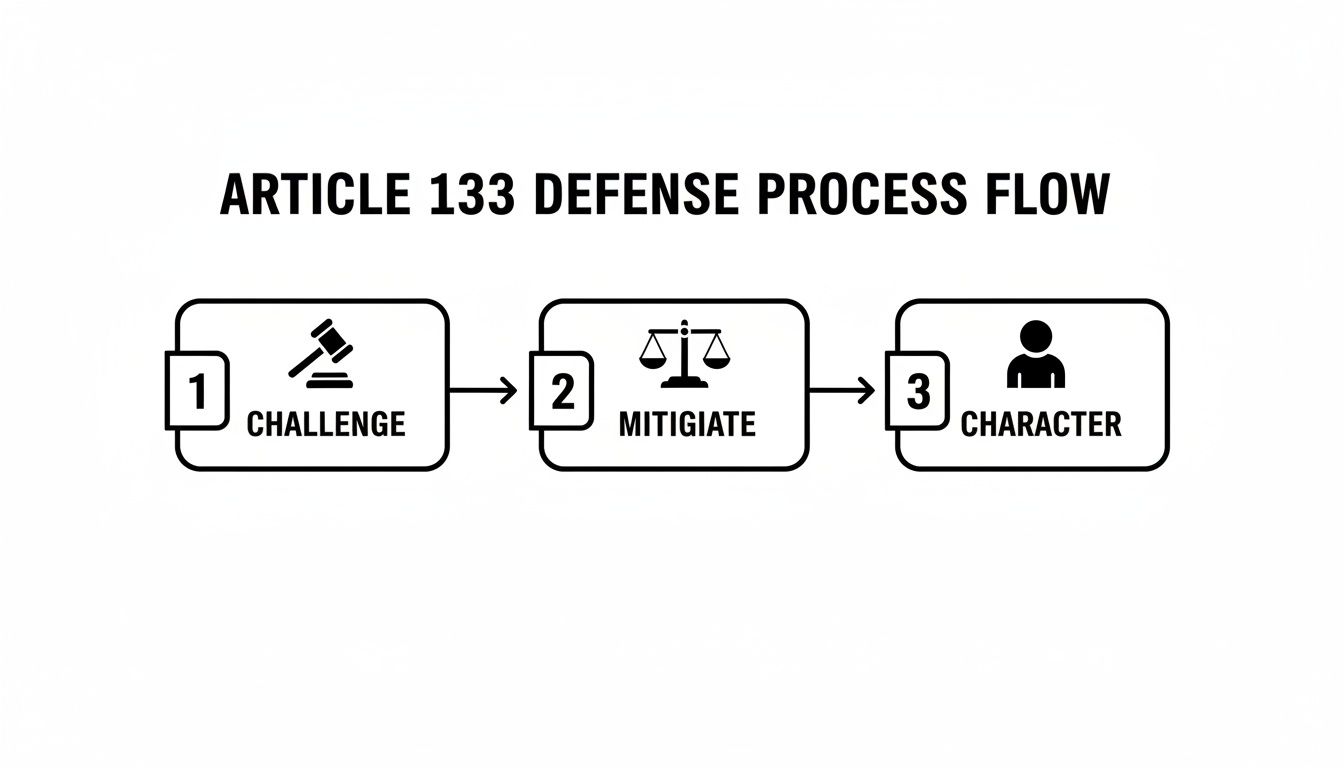
As you can see, a powerful defense isn't just about one thing. It's a multi-front battle that involves challenging the charge itself, mitigating any potential fallout, and strategically using your record and character. This fight starts the moment you're aware of the investigation.
Crucial Takeaway: Your silence is your best shield. The urge to cooperate is powerful, but you must understand that investigators are not your friends. Their only goal is to close their case. Giving them a statement without counsel present just hands them the tools to close it at your expense.
Exercising your rights isn’t an admission of guilt—it’s a cornerstone of the military justice system. To get a more detailed breakdown of this critical phase, you should read our guide on how to protect your rights during a command investigation for a deeper tactical look.
Frequently Asked Questions About Article 133
When you're facing an Article 133 UCMJ charge, the questions come fast and furious. It's a confusing and high-stakes situation. This section cuts through the noise to give you direct answers to the most common concerns we hear from officers, clarifying the process and building on the guidance from the rest of this guide.
Can I Be Charged Under Article 133 for Off-Duty Conduct?
Yes, absolutely. This is one of the biggest shocks for many officers. Unlike articles tied to specific military duties, Article 133’s reach extends deep into your personal life.
The legal test is simple: did your off-duty conduct bring discredit upon the armed forces or otherwise compromise your character as an officer? Things like financial irresponsibility, a messy public dispute, or even certain online activities can easily become the basis for charges. The military’s view is that an officer represents the service 24/7, and your conduct, on or off the clock, must always meet that standard.
Is an Article 15 a Better Option Than a Court-Martial?
In many cases, yes. Resolving an Article 133 allegation with Non-Judicial Punishment (NJP) under Article 15 is a far better outcome than a court-martial. An NJP keeps a federal conviction off your record, and the punishments—like restriction or forfeiture of pay—are significantly less severe than dismissal.
But don't be fooled; accepting an NJP is still an admission of guilt, and it can cripple a career. It almost always leads to a negative performance review or a letter of reprimand. You should never, ever decide whether to accept NJP without first having an experienced military defense attorney review the evidence against you.
A critical point to remember: While NJP avoids a criminal record, the finding of guilt can still be used to justify administrative separation, potentially ending your career through a Board of Inquiry. It's a calculated risk, not a get-out-of-jail-free card.
How Does a Lack of Notice Defense Work?
The "lack of notice" defense attacks the vague, catch-all nature of Article 133. The core argument is that your conduct wasn't so obviously wrong that a reasonable officer would have known it was out of bounds. To secure a conviction, the prosecution has to prove that military customs or regulations clearly put you on notice that your actions were unacceptable.
If your defense attorney can show that the standards for your specific behavior were unclear or fell into a legal "gray area," it can create the reasonable doubt needed for an acquittal. This defense is highly fact-specific and requires a deep understanding of military culture and case law. For example, conduct that is constitutionally protected in the civilian world, such as possessing certain types of "virtual" or computer-generated explicit material, might still be punishable under Article 133 if it’s deemed to compromise an officer's moral standing.
This defense brings the classic tension between individual rights and military necessity to the forefront—a common battleground in Article 133 UCMJ cases. When argued effectively, it can dismantle the government's case from the inside out.
An Article 133 charge threatens everything you've built. The unique complexities of military law demand an aggressive and experienced defense. If you are under investigation or facing charges, contact Gonzalez & Waddington for a confidential consultation to protect your career, reputation, and future. https://ucmjdefense.com